






TL;DR
The cart stage is where interest meets hesitation. At this point, visitors are engaged, but not yet convinced enough to complete their order. A clear goal, like a free shipping threshold or a reward milestone, gives shoppers a clear goal to walk toward. When used thoughtfully, these elements can reduce abandonment, increase order value, and keep customers coming back.eCommerce gamification is changing how online stores interact with customers. By introducing game-like elements such as progress bars, rewards, and milestones, online stores can make the shopping journey more engaging and goal-friven. For merchants using platforms like Shopify, these mechanics work best at the cart stage. A little extra motivation here can reduce cart abandonment.
This article will break down how eCommerce gamification strategies work, their key benefits, and how to apply them effectively to Shopify cart page design.
1. What is eCommerce gamification?
1.1 Definition of gamification in eCommerce
Gamification is the use of game design elements in non-game contexts. In eCommerce, this means integrating game-like experiences into the online shopping journey. By leveraging shopping experience, businesses can increase customer engagement and encourage purchases.
1.2 Popular techniques of eCommerce gamification
eCommerce gamified experience is not a "secret weapon" only for big brands. You don’t need to be a game developer to use it. You can quickly add game mechanics to your current marketing plan without a complex setup.
a. Spin the wheel
- The chance to receive rewards easily with very few steps.
- A unique and standout design (Opt-in).
- The brand has full control over setting up the wheel: types of prizes, the number of slices on the wheel, colors, content, etc.

Temu introduces the discount wheel for first-time visitors.
Spin the wheel also helps you collect email from first-time visitors and grow your email lists. You can then reach out to them later to drive their first purchase.
b. Quiz game
Quizzes lets customers answer a few simple questions to get personalized product recommendations. They make product discovery more engaging and reduce decision fatigue. Brands also gain valuable insights into customer preferences and improve future marketing.
Start with easy questions about gender, age, or budget, then move to deeper ones like style (classic or sporty), favorite colors, or patterns.
Use both multiple-choice and open-ended questions related to your products. After the quiz, users will receive tailored rewards and suggestions.

Answer quizzes from Warby Parker to get more personalized shopping experience.
c. Customer loyalty programs
Loyalty programs reward customers with points for actions like making purchases, leaving reviews, referring friends, or celebrating birthdays. These points act as small achievements and encourage customers to stay active.

Redeem points on Tarte VIP for discounts or gifts.
Points can later be redeemed for discounts or rewards. Over time, reward points can create long-term value. They motivate customers to keep connected with the brand to reach new tiers of rewards.
d. Progress bars
Progress bars show customers how close they are to a reward, such as free shipping or a bonus gift.
Seeing clear progress encourages action. When shoppers are just short of the goal, they are more likely to add another item to their cart.
You can place progress bars on cart pages or at checkout to guide decisions. Adding success animations or messages makes the final transaction feel like a win.
e. Competitions & Challenges
- You can offer rewards for specific tasks (e.g. a gift for early buyers, a discount for referrals) within a set time.
- You can also run contests to increase your brand's visibility. Ask customers to share photos or content featuring your products, then reward the most creative entries.
These interactions do more than just drive sales. They turn individual shoppers into a supportive community that grows alongside your brand.
2. Benefits of online shopping gamification
2.1 Increasing customer engagement
Keeping customers engaged is essential, especially in a competitive online environment.
Gamification for online stores user experience adds interactive elements that make the shopping experience more dynamic and enjoyable. These simple features can encourage users to explore and stay longer on the site. Rather than passively browsing, customers become active participants in the shopping journey.
Gamification strategies in e-commerce can increase customer engagement by up to 40%.
- Sharing content on social media
- Inviting friends
- Browsing products
- Adding items to cart
- Or, completing a purchase
When incentives like discounts, promo codes, or free gifts are included, games become even more appealing. This allows brands to connect with customers without putting pressure to buy on them. When people enjoy the journey through your store, they might feel good about buying from you.
2.2 Reducing cart abandonment
Abandoned carts are a major challenge in online shopping. Customers may add multiple items to their cart, but hesitate and leave without completing the purchase. The hesitation often happens because the motivation to finish is not strong enough.
Want to explore what could make shoppers abandon their carts? Check out our detailed guide we've made for you!
Digital commerce gamification helps push the customer to move forward. By introducing elements like progress bars, reward thresholds, or free shipping unlocks, the checkout process becomes more goal-driven.
When a reward is close, customers are encouraged to take one small extra step. They might add one more item or complete their order to receive a benefit.
2.3 Driving sales growth
Beyond reducing cart abandonment, eCommerce gamification is a great way to boost your sales and average order value.
Imagine when a customer wins a discount through a game, it feels special to them. They are much more likely to use that code than a random one they found on a banner.
- Domino's saw a 30% increase in sales during the campaign.
- The app was downloaded over 328,000 times, reaching the Top 3 on the App Store.
- Players created over 7 million digital pizzas through the app.
- The game helped 800 people find jobs at their local Domino's stores.

The start screen of Domino's Pizza Hero.
2.4 Strengthening customer loyalty
Building customer loyalty is not easy, but it is essential for long-term success. Many buying decisions are influenced by habit. Once customers feel familiar with a brand, they are more likely to return.
Gamification design in eCommerce helps reinforce this behavior through points, reward systems, and milestone achievements. Each interaction feels recognized, which gives customers a reason to come back.
These moments build a stronger connection between the customer and the brand. Instead of a one-time transaction, the relationship becomes more ongoing and meaningful.
2.5 Encouraging long-term value
Acquiring new customers can be significantly more expensive than retaining existing ones. Even small improvements in retention can have a meaningful impact on profitability.
Gamified online shopping encourages repeat interactions and purchases to retain customers and build long-term loyalty. Over time, a real bond begins to form. As familiarity grows, so does trust. When it’s time to buy again, people naturally go back to a brand they already know and like.
3. How could you apply gamification design on the Shopify cart page?
The cart page is often where hesitation begins. Even interested shoppers may leave if the next step feels unclear or not valuable enough.
Adding online retail gamification to the cart stage introduces gentle guidance. With clear progress, achievable goals, and small rewards, the cart experience becomes more interactive and reassuring. Therefore, customers would feel more confident about completing their order.
3.1 Progress bars
A cart progress bar shows customers how close they are to a reward, such as free shipping, a discount, or a bonus gift. As items are added, the bar fills up and clearly displays what’s left to reach the goal.
🎁 A message like "You’re $15 away from free shipping" informs that you need to spend $15 more to unlock free shipping. It gives customers a clear and achievable target, and guides them what to do next.
Progress bars work because of the Goal Gradient Effect. The nearer the reward feels, the more motivated people become. When shoppers see they are only a small amount away from a benefit, they are more likely to add one more item to reach it. A visible, near-complete goal creates momentum and makes the decision easier.
- Free shipping bar: no shipping fee when a spending threshold is reached
- Discount threshold: offers a percentage or fixed discount at a certain spending level
- Free gift bar: gives a bonus item when customers reach the required amount
- Tiered progress: unlocks multiple benefits at different spending levels
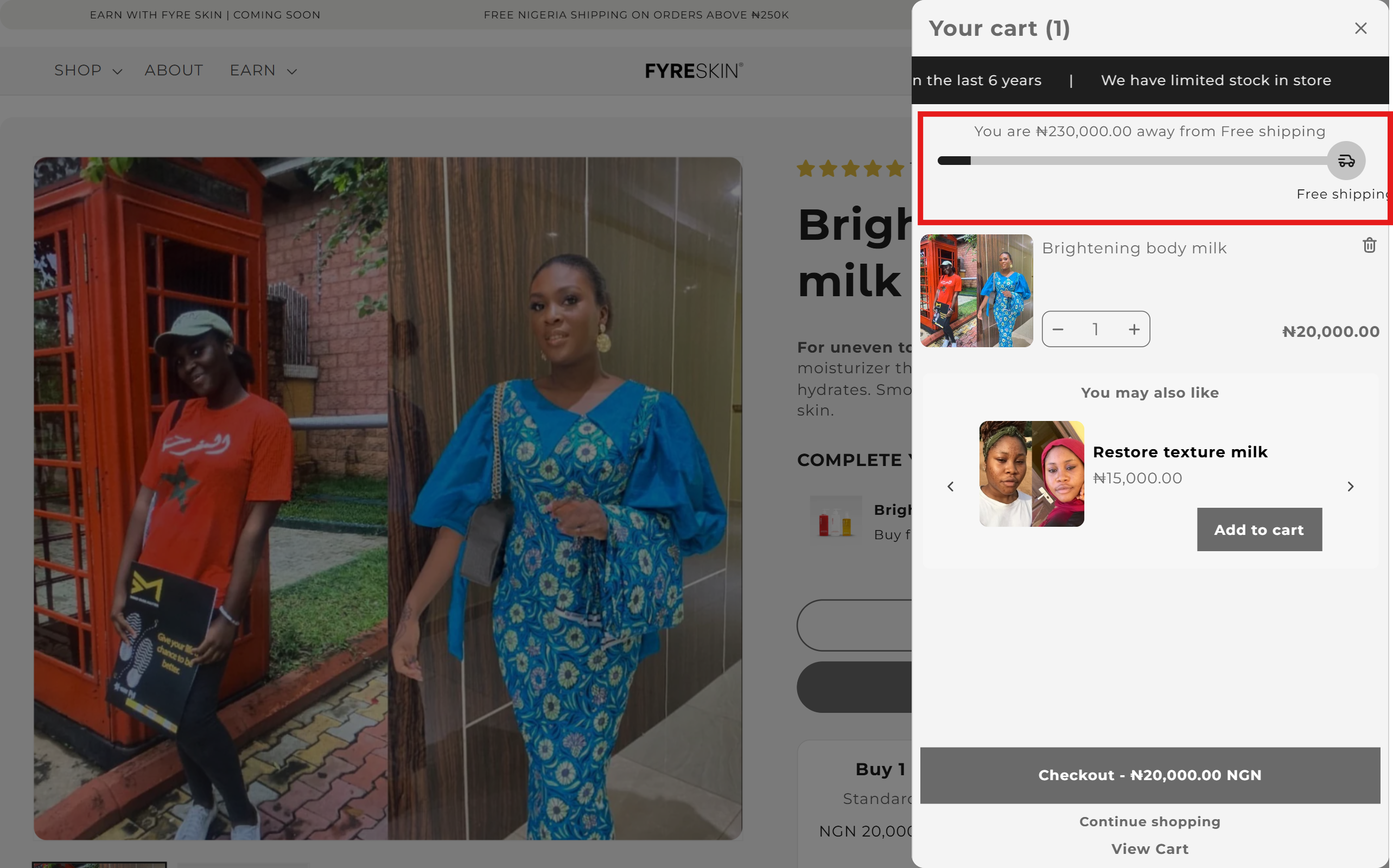
A free shipping bar will look like that.
Best practices for most effective progress bars
- Keep the design simple: use only 3-4 clear steps to avoid overwhelming customers
- Show progress clearly: highlight completed steps with simple visuals like filled bars or checkmarks
- Use familiar labels: terms like Discount, Shipping, and Gift are easy to understand
One important tip: Set the reward threshold slightly higher than your average order value. It can push customers to spend more, not just rewarding behavior that would happen anyway.
3.2 Reward-based milestones
Milestone rewards work best when placed directly in the cart, where customers are already deciding whether to check out. Rather than only a big goal, you break the progress bar into smaller, achievable stages.
Each time a reward is unlocked, the next one appears right away, giving customers a clear reason to continue.
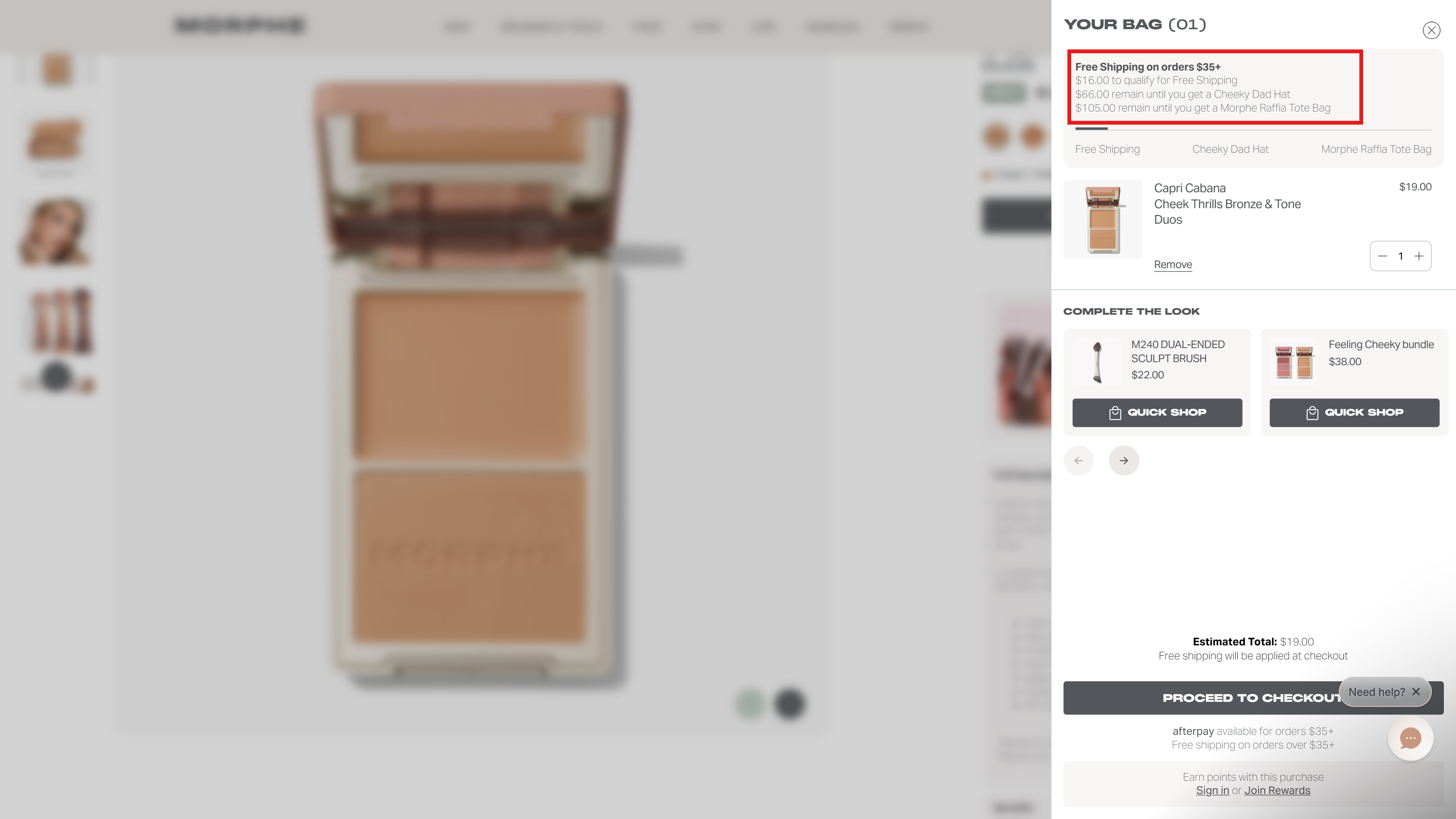
How Morphe sets their reward milestones.
How to add appealing milestone rewards
- Visual checkpoints: Display each reward clearly in the progress bar so customers can see what is locked and what is close. Small visual cues make the shopping process feel like a simple challenge.
- Celebrate progress: When a milestone is reached, use a short message like "You’ve unlocked free shipping" to confirm the achievement.
- Keep early goals easy: The first milestone should be slightly above the average order value so customers can reach it quickly and feel motivated to go further.
3.3 Dynamic cart goals
Dynamic cart goals adjust in real time based on what customers add to their cart. Instead of giving everyone the same target, a dynamic system changes the goal, the message or the reward to be more relevant to the person currently browsing.
- Smart thresholds: Cart goals automatically scale to the customer's current spending level.
🏖️ For example, if a shopper has $80 worth of items, the system might suggest a $10 milestone. But if they already have $150, the goal can shift to $200 for a higher-value reward.
- Personalized rewards: Different customer groups receive different incentives, such as:
New customers Loyal customers Free Shipping on first order Bonus points, exclusive rewards - Contextual messaging: Cart messages update in real time to reflect what customers add or remove.
Tips to optimize your dynamic cart goals
- Suggest complementary products: If a customer needs $15 more for a reward, show small, relevant items in that exact price range inside the cart.
- Limit the number of goals: Do not use too many milestones. 2 or 3 tiers work best.
- Test different targets: Experience with distinct goal amounts above your average order value to find the ideal balance for your specific audience.
4. Common mistakes Shopify merchants make with gamification
Even with the best intentions, some Shopify stores accidentally weaken their gamification efforts. Avoiding these common pitfalls keeps your cart incentives effective, trustworthy, and user-friendly.
Overload the cart with messages:
Too many banners, pop-ups, and alerts can distract customers right when they are about to buy. Interactive promotions should support the checkout process, not take it over.
Use fake urgency:
Fake countdowns and false progress bars might increase clicks, but they ruin customer trust. Shoppers are smart and quickly notice when a timer resets or doesn't match reality. True loyalty relies on transparency.
Poorly set reward thresholds:
If the reward is too hard to reach, customers will give up immediately. In contrast, if it’s too easy, it doesn’t influence behavior or increase value. The target needs to feel both valuable and reachable.
Ignore mobile UX:
Mobile traffic makes up a large portion of Shopify store visits. Game elements that look great on desktop may become confusing on smaller screens. Buttons that are too small, progress bars that don’t scale, or pop-ups that cover key actions can all reduce effectiveness.
Design for mobile first to ensure your incentives are usable for the majority of shoppers.
Final thoughts
A gamified cart design can gently guide customers from browsing to buying. However, effectiveness depends on balance. Gamification should support the shopping experience, not distract it. Simple design, realistic thresholds, and mobile-friendly layouts help maintain trust while improving performance.
Frequently asked questions about gamification for online stores
1. How does gamification in online retail reduce cart abandonment?
Gamification reduces cart abandonment by giving shoppers a clear reason to keep going. Simple cues like "You’re $10 away from free shipping" or milestone rewards make the next step obvious and help them overcome hesitation.
2. What are common mistakes to avoid when using game mechanics in eCommerce?
Keeping the experience simple and transparent is key to success. Common mistakes include:
- Overloading the cart with too many messages
- Using fake urgency or misleading rewards
- Setting unrealistic thresholds
- Ignoring mobile user experience
3. Can small Shopify stores use gamified cart design?
Yes. Gamification is not limited to large brands. Many Shopify apps allow small and medium stores to add progress bars, rewards, and incentives without complex setup.