






TL;DR
BOGO strategies effectively boost average order value. To protect profit margins, select the right format (Free vs. 50% off), set minimum spend thresholds, and pair complementary, high-margin products. Instead of just focusing on larger basket sizes, always measure your promotional campaign's success by actual contribution profit, not just revenue.The best BOGO strategies do more than increase sales. When structured correctly, they can raise average order value, improve product mix, and encourage larger purchases without sacrificing profit. This guide explores proven buy one get one free tactics, when to use them, and how to structure offers successfully.
1. How BOGO strategies increase AOV
BOGO (Buy One, Get One) promotions increase AOV by encouraging customers to add extra items to their cart in exchange for a reward. Instead of reducing the price of a single product, BOGO increases the number of products purchased in the same order.
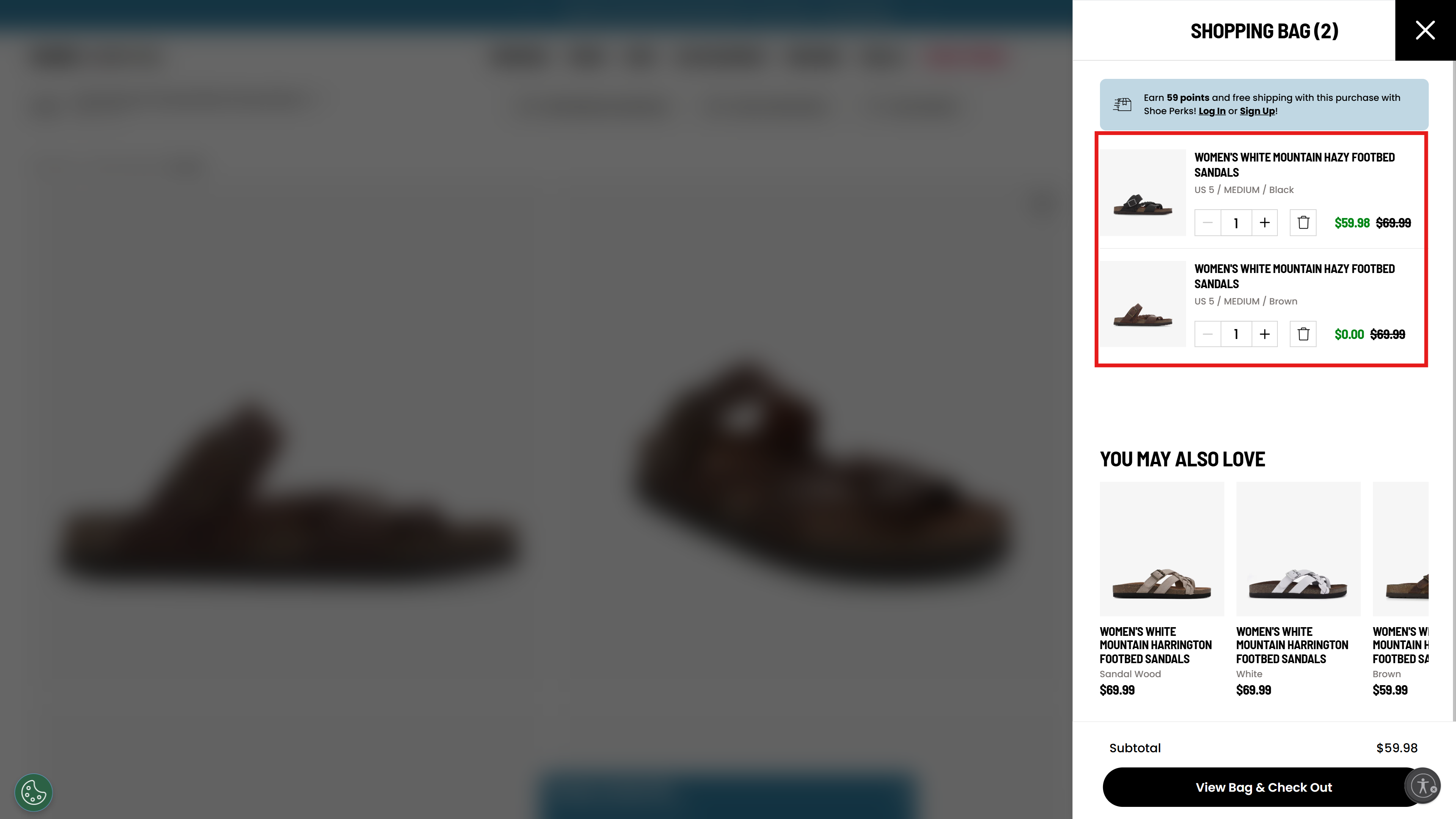
Buy one sandal, get the free one.
Buy one get one free gives shoppers a clear reason to expand their cart. They can unlock additional value by adding another eligible item or reaching a spending threshold.
For more information, please check our comprehensive guide about BOGO, gift with purchase and more.
2. Which BOGO formats drive higher order value
2.1 BOGO free vs BOGO 50% off
Buy one get one free is simple and highly visible. It can fit when the extra unit has healthy margins, low shipping costs, predictable demand, or inventory pressure. Because the value is obvious, it can create a stronger emotional response than a complex tiered discount. This reflects the Zero Price Effect, where consumers respond strongly to anything offered for free. In a well-known experiment, Hershey's chocolates were dropped from 1 cent to free while Lindt from 14 to 13 cents. Demand for Hershey's jumped dramatically despite other options providing better value.
The limitation is the size of the price reduction. On a true buy one get one free offer, customers receive two units while paying for only one. If margins are already tight or fulfillment costs are high, the promotion can increase revenue while putting pressure on profitability.
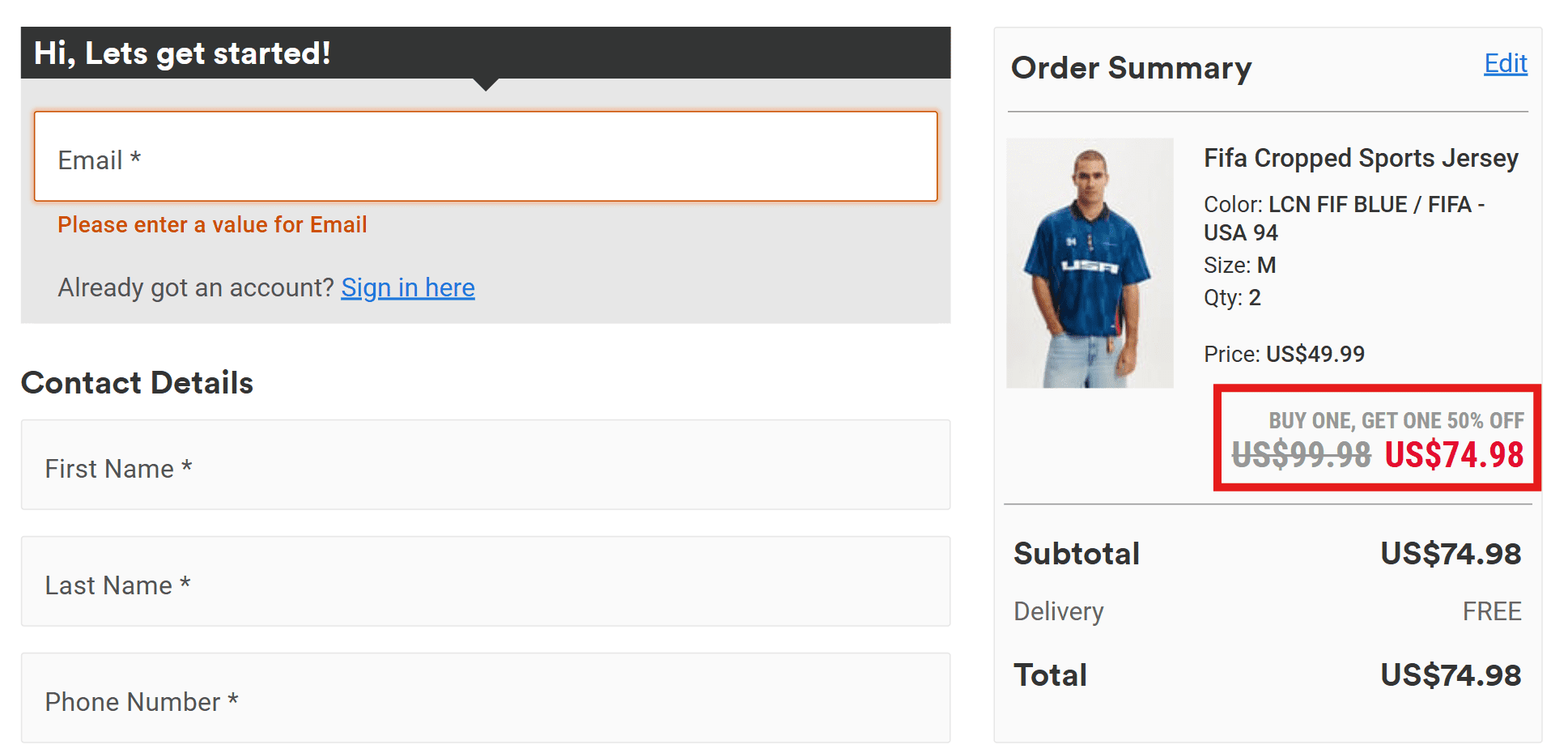
Buy one, get another with 50% off.
Buy one, get one 50% off is more controlled. It still encourages a second item, but the merchant preserves more revenue. This format may suit steady-demand products where you do not need the urgency of a free item. Its weakness is that it may not feel as compelling as a free-item offer, especially if competitors run deeper deals.
2.2 When mix-and-match outperforms same-item offers
Same-item BOGO promotions are clean: buy one T-shirt, get another T-shirt. They can make sense for consumables, basics, refills, socks, pantry goods because customers already buy in multiples. However, it can also pull demand forward. Shoppers who stock up during the promotion may delay their next purchase.
Mix-and-match BOGO deals may be more effective when the goal is product discovery or cross-selling. Use mix-and-match when:
- Products complement each other.
- Eligible items have similar margins.
- The offer helps buyers build a set.
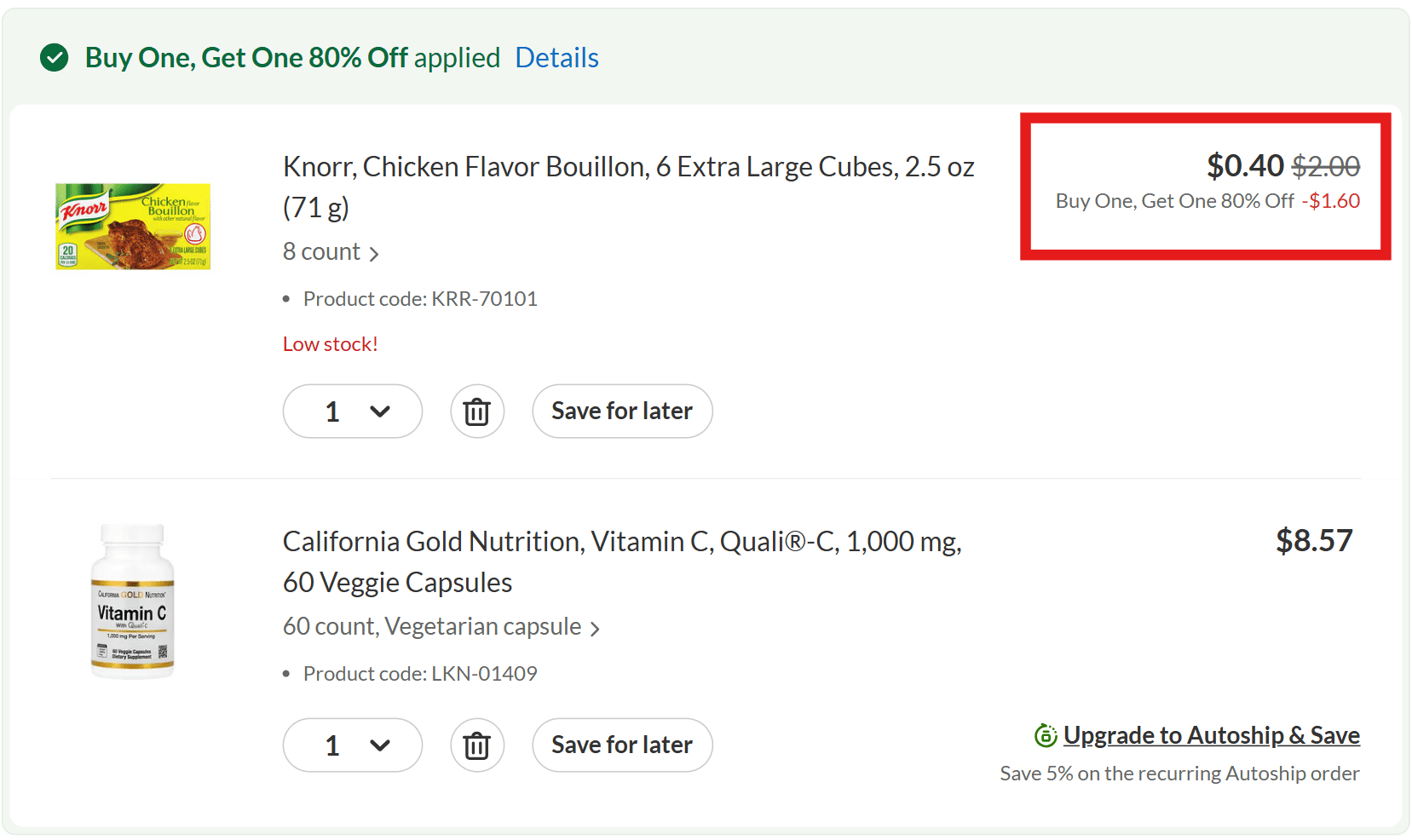
Mix and match BOGO where the discounted item is different from the main product.
Avoid it when margins vary widely, because purchasers may choose the most expensive discounted item.
2.3 Impact on conversion rate and margin efficiency
A stronger offer may lift conversion and AOV, but that does not make it the best choice. The more important question is how much profit the promotion generates after accounting for discounts and additional costs.
- 2-for-1 free strategies often attract the most attention.
- BOGO with 50% discount typically protects margin more effectively.
- Mix-and-match can boost units per order and discovery. McKinsey research confirms that strategic bundling boosts sales by 20% and profits by 30%.
- Tiered BOGO offers may raise cart size, but they also introduce more complexity.
Quick summary: Here's a quick comparison of when each multiple-buy promotional offer tends to work perfectly:
3. How to design BOGO offers that protect profit margins
Before a BOGO campaign goes live, Shopify merchants should know SKU margins, shipping costs, return rates, inventory levels, and current AOV. Without this context, the offer is just a louder price breakdown. The key is to evaluate buy one get one pricing strategies based on profit impact, not just higher AOV. According to Statista, the average retail ecommerce margin sits around 7%, with pre-tax profit margins at 1.3%.
3.1 Set minimum order value or quantity thresholds
Thresholds are one of the simplest ways to control discount costs. Rather than storewide buy one get one free, require a minimum spend, quantity, or category-specific purchase before the reward becomes available.
Set the threshold modestly above current AOV. If your AOV is $80, test a BOGO offer that activates at $95 or $100. The goal is not only to increase cart value but also to improve profit per order.
3.2 Choose product pairings that support profitability
Choose BOGO products with strong margins, low shipping costs, and a natural relationship. Good candidates can be accessories, refills, samples, travel sizes, care products, etc.
Pairing low-margin items together can quickly erode profit. If the free item is bulky, fragile, or often returned, the promotion can become costly even when sales increase. National Retail Federation and Happy Returns reported that retailers estimate that 16.9% of their annual sales were returned. Statista Consumer Insights data also confirmed that clothing is the most frequently returned product category for U.S. online shoppers, accounting for 25%.
Like bundles and upsells, effective free gift with purchase strategies should be built around buyer purchase intent, not simply excess inventory.
3.3 Avoid over-discounting items with high demand
Be careful when applying BOGO promotions to items shoppers already buy at full price. Bestsellers, new arrivals, and limited-stock items often work better as the qualifying purchase rather than the reduced pricing reward.
This is especially relevant for new launches, bestsellers, and products with limited inventory. Discounting them can teach purchasers that waiting is rational. It can also drain stock that may have sold without promotion.
It is also worth using exclusions. Exclude low-margin products, new arrivals, limited editions, and items with high return rates. A narrower BOGO campaign is often easier to manage and more profitable over time.
4. What product pairing and threshold rules make BOGO offers increase basket size
No buy X get Y rule guarantees higher basket size in every store. However, some approaches consistently make buyers more likely to add extra items.
4.1 Pair products that naturally belong together
Complementary products make the original purchase more complete rather than adding random items.
- A dress with a belt
- A camera with a memory card
- Coffee beans with filters
- Shampoo with conditioner...
When the second item clearly complements the first, customers need less time to evaluate the offer and are more likely to add it to their cart.
4.2 Use purchase history for dynamic pairing
Purchase history can make 2-for-1 deals more relevant.
- Returning customers may respond well to same-product offers.
- Purchasers who bought a core product may be interested in refills or accessories.
- Category shoppers often prefer related add-ons over unrelated clearance items.
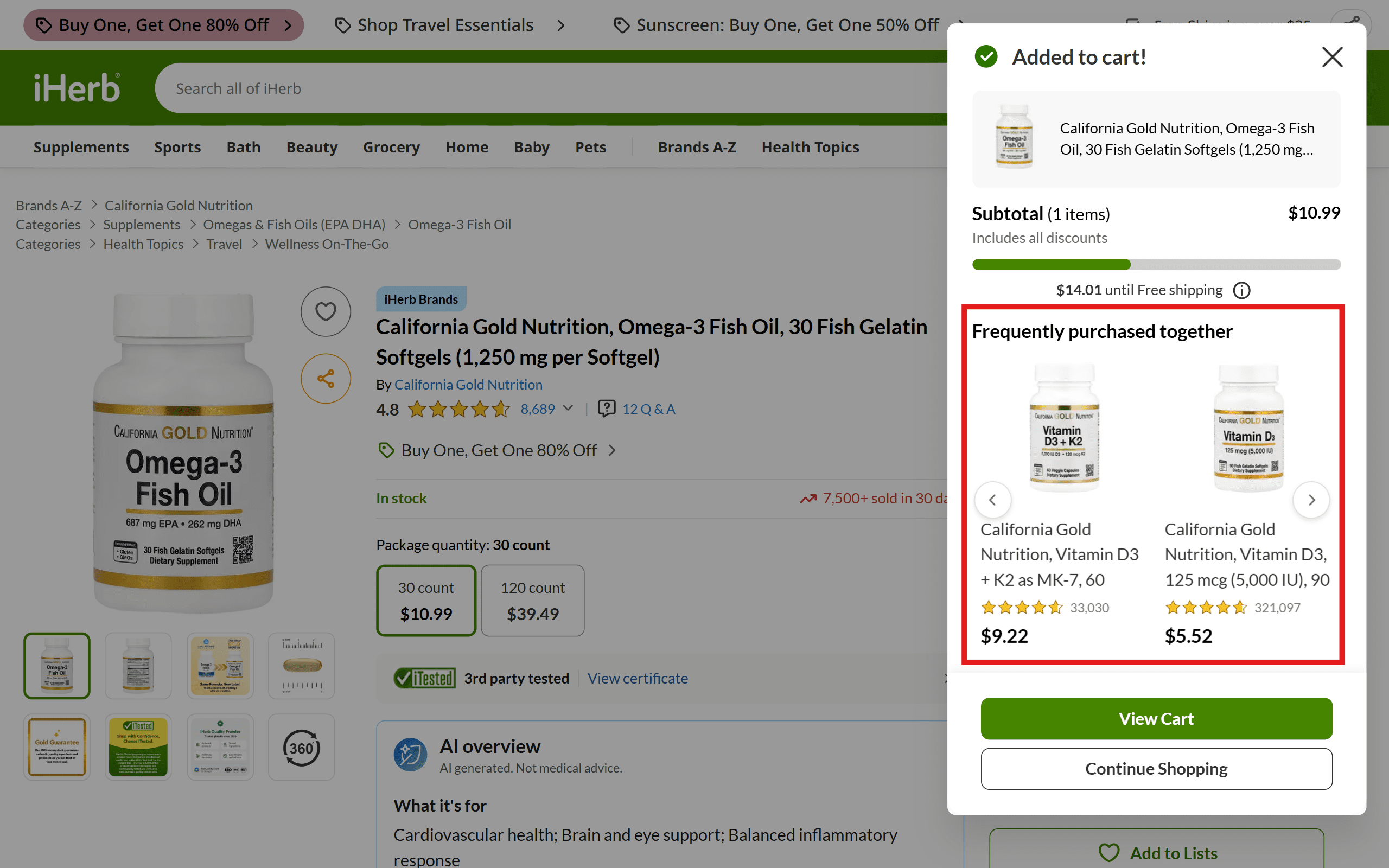
Use frequently bought together data to suggest complementary items.
Start with a small number of proven product combinations before expanding to more personalized offers.
4.3 Apply tiered incentives to encourage larger orders
Tiered BOGO discounts can pull customers toward larger carts. The thresholds should feel reachable to motivate action. Messages shown in the cart or cart drawer can be useful because shoppers can immediately see what they need to do.
But make sure the rules are simple. Too many exclusions, categories, or stacking conditions can create confusion and reduce participation.
5. When should use BOGO, percentage discounts or other promotions
Apply BOGO strategies when the business goal is to increase units per order, expand basket size, move specific inventory, or introduce specific products. Percentage discounts tend to be better when the goal is to provide immediate savings or support customer acquisition.
5.1 Use BOGO for inventory clearance
BOGO can help clear excess inventory without lowering the perceived value of the primary product.
- Use for overstocked items, seasonal products, replenishment goods, and complementary add-ons.
- Do not use buy one get one to clear inventory that are expensive to fulfill, frequently returned, or disappoint buyers.
5.2 Use percentage discounts for acquisition
For new customer acquisition, percentage discounts are often easier to communicate through ads, email campaigns, and landing pages. First-time visitors have limited trust and context, so they are less likely to spend time figuring out a conditional deal. Multiple-buy promotional offers may require more consideration, so reserve them for situations where shoppers already understand the stores (e.g. products page, cart, follow-up emails).
5.3 Match promotions to customer segments
Price-sensitive shoppers tend to be motivated by immediate savings. Loyal customers may value early access, gifts, bundles, or replenishment deals. Some high-intent buyers may need no price reduction at all. Segment BOGO discount campaigns based on behavior:
- New visitors: simple BOGO, percentage discounts
- Repeat buyers: replenishment, multi-buy offers
- VIP customers: gifts, bundles, threshold-based rewards
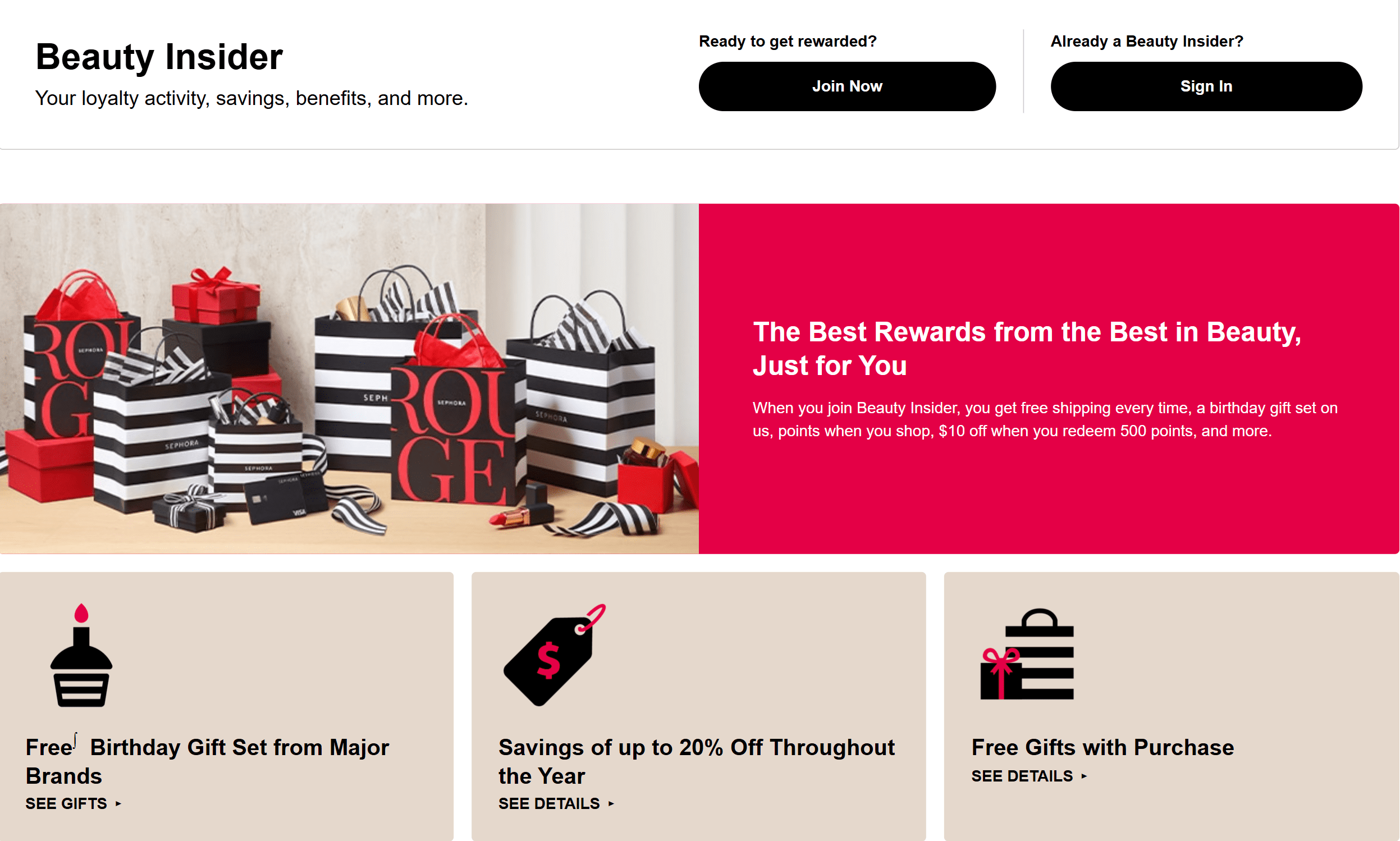
Join Sephora Beauty Insider to unlock member exclusive perks.
Be careful not to overuse BOGO strategies. Over time, purchasers may learn to wait for the next promotion.
6. How to measure the real impact of a BOGO strategy
6.1 Track the metrics that matter
Instead of focusing on a single KPI, evaluate the campaign from multiple angles:
- AOV - Whether shoppers spent more per order
- Units per order - Whether basket size increased
- Attach rate - Whether shoppers added the promoted item
- Gross margin - Revenue remaining after product costs
- Contribution profit - Profit after discounts, shipping, and fees
- Redemption rate - How often buyers used the offer
- Return rate - Whether discounted orders generated more returns
Also break down results by traffic source, consumer type, category, and device.
6.2 Evaluate performance after the promotion
The final test comes after the campaign ends. Compare shoppers who redeemed the offer with others who did not. Look for changes in:
- Repeat purchase rate
- Time to next order
- Second-order value
- Profitability
- Refund and return behavior
Finally, review customer feedback, support tickets, and reviews.
Conclusion
The most successful buy one get one free tactics are about creating better carts, not just bigger carts. As you test different BOGO strategies, focus on the quality of the order rather than the size of the promotion.
When the offer encourages meaningful product discovery, increases purchase value, and supports healthy margins, both the customer and the business benefit. Over time, BOGO pricing becomes a sustainable way to grow AOV and revenue.
FAQs
1. How can a BOGO offer increase average order value?
A BOGO offer increases AOV because it requires shoppers to add more to the cart than they originally planned. Common ways include:
- Setting a minimum spend
- Using buy two get one free instead of buy one get one free
- Applying the offer only to higher-margin products
- Making the free item a complementary add-on rather than the same product.
2. Should the free BOGO item be the same product or a different product?
Apply the same product for consumables, beauty products, supplements, food, and household items because buyers can use more of the same item. A different free product works better when the goal is cross-selling, product discovery, or increasing perceived value.
3. How often should a brand run BOGO promotions?
BOGO promotions should usually be used selectively, during:
- seasonal campaigns
- product launches
- inventory clearance
- customer reactivation
- holiday shopping periods
Running multi-buy strategies too often can train purchasers to wait for discounts and reduce full-price sales.