






TL;DR
Choosing between BOGO and free gifts depends on your core business goals. Use BOGO to drive sales volume and move inventory efficiently. Alternatively, leverage free gifts to increase AOV, encourage product discovery, and maintain premium pricing. Always measure success by tracking actual profit margins, not just conversion rates.In the BOGO vs free gifts debate, the winner is the one that serves better what you want to achieve. BOGO discounts are often used to drive volume and move inventory. Meanwhile, bonus gifts can encourage larger orders, and support product discovery. This guide breaks down the key differences so you can choose the incentive that best fits your store.
1. Understanding BOGO vs Free gifts
1.1 What is BOGO
BOGO, short for Buy One, Get One, is a promotion where customers receive an additional item after purchasing a specific product or quantity. The reward may be free, partially discounted, or offered at a reduced price.
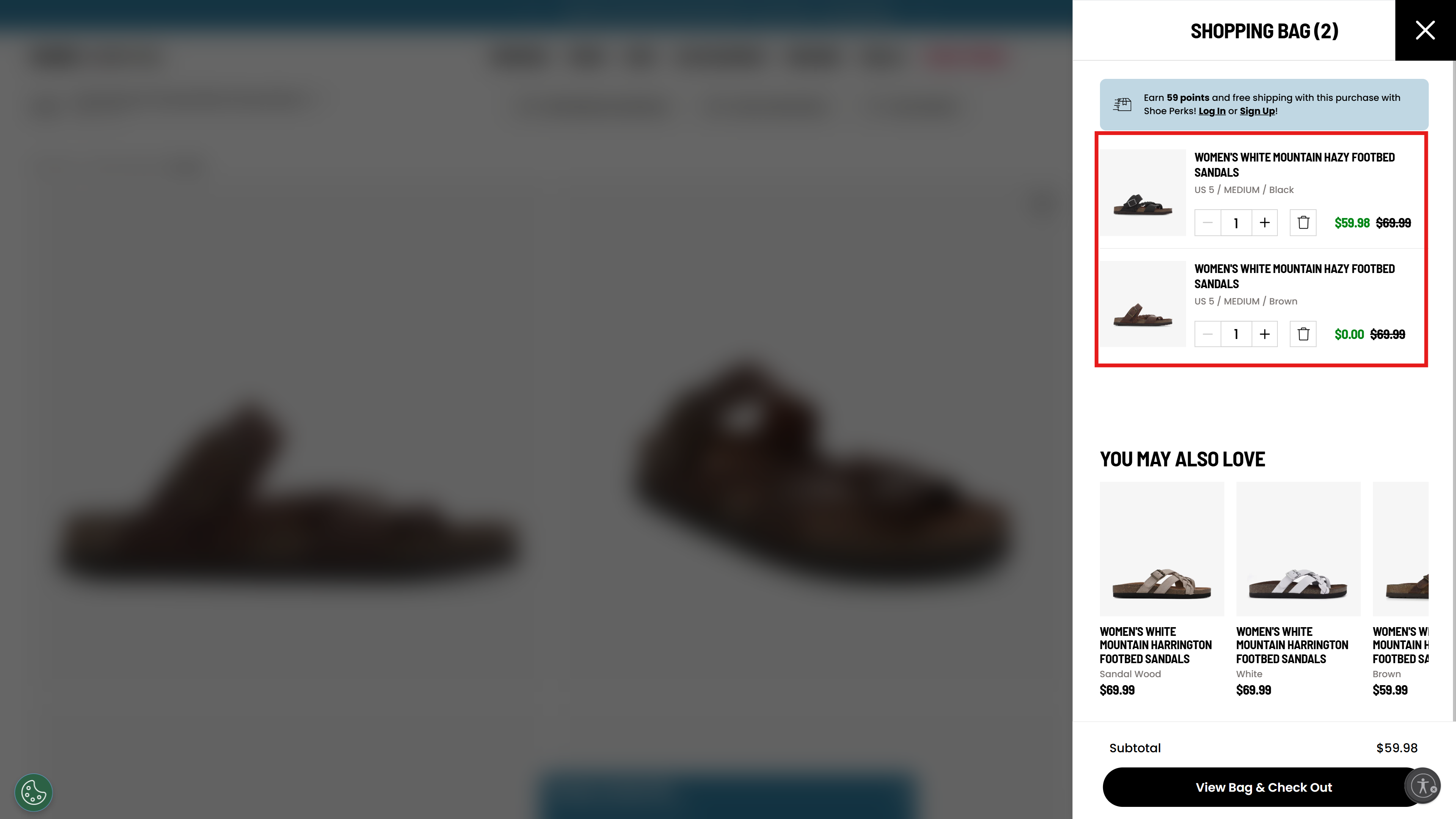
An example of buy one get one free.
The goal of buy one get one free is to encourage much more sales volume by increasing the perceived value of the order. Buyers are responding to a lower effective price per unit, even if the sticker price on the product page does not change.
1.2 What are free gifts
Free gifts (also known as Gift with Purchase) reward shoppers with a complementary item after they meet a specific condition:
- reaching a minimum spend threshold,
- buying from a curated collection,
- or selecting a featured product.
The bonus gift is usually distinct from the main purchase because it is presented as an exclusive perk rather than a price reduction.
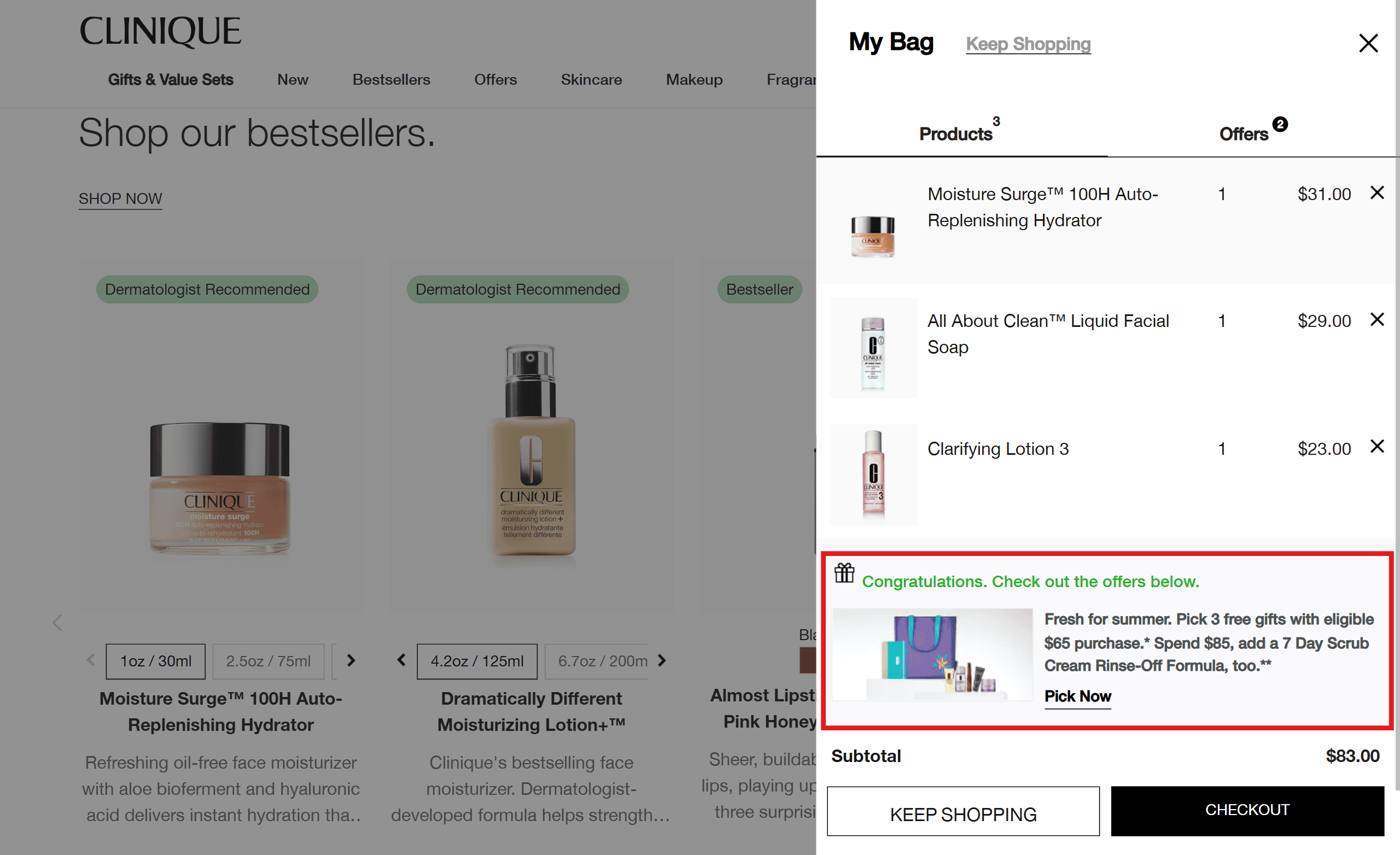
An example of gift with purchase.
For deeper understanding of incentive strategies, please explore our thorough guide we've made for you!
1.3 Key difference between buy one get one and free gifts
Although both BOGO offers and gift with purchase are designed to drive conversions, they influence consumer behavior in different ways. BOGO sales focus on quantity, while freebie promotions are value-driven.
When used strategically, both models can boost sales without relying on a traditional discount. The winning choice depends on whether your goal is to clear shelves quickly or enrich the shopping experience while increasing cart size.
2. BOGO vs Free gifts: Which offer is more profitable?
2.1 The real cost of BOGO discount
The more profitable offer is not always the one with the highest conversion rate. A BOGO deal may lift orders, but it can also reduce margins quickly if the free or discounted item has a high cost of goods, needs extra packaging, or increases shipping weight.
One paid item has to carry enough gross profit to cover the second unit, fulfillment, payment fees, and any added shipping. If the numbers do not work at the order level, the campaign may sell more while earning less.
2.2 The real cost of freebie promotion
For a free gift, profitability depends on the gift cost and the spending threshold. A low-cost gift attached to a meaningful requirement can preserve margin well. However, the offer becomes less attractive when:
- The gift seems poor value to customers
- The gift that is too expensive to source, pack or ship
The best gifts usually have a healthy gap between perceived value and actual cost. Buyers respond to how valuable the gift feels, while your margin depends on what it truly costs to provide.
2.3 Hidden costs that affect profitability
A promotion that looks cheaper on the surface is not always the safer financial choice. A low-cost item may still reduce profitability when:
- Creating extra handling or fulfillment work
- Requiring custom packaging or inserts
- Motivating customers to add only the minimum spend to reach the threshold
Shipping and returns can further affect the results. Consider:
3. How customers perceive BOGO deals compared with free gifts
3.1 Why BOGO creates urgency
Customers often view BOGO deals as straightforward savings: they get more products for the money. The obvious value makes BOGO effective when shoppers are comparing options, stocking up, or deciding whether to buy now or later. 93% of US consumers have redeemed a BOGO offer.
Buy one get one also creates natural urgency. If the offer is tied to a limited-time promotion or a specific product, purchasers may feel they are missing out on a clear deal if they wait.
Gift with purchase is often perceived as added value rather than a price reduction. Rather than lowering the core product's price, they reward customers with something extra.
That is one reason freebie promotions tend to perform best for brands that care about image and positioning. A well-chosen gift can reinforce the quality of the main purchase. To be efficient, the gift should be:
- Relevant to the order
- Easy to notice and understand
- Tied to a logical purchase condition
3.3 When discount fatigue makes a free gift campaign safer
If shoppers are already seeing frequent discounts, another price cut may feel less compelling. Instead, gift with purchase encourages buying without making the product seem permanently discounted. This can be especially valuable to protect pricing power and long-term customer perception.
The key is choosing the intentional gift. If the item looks unrelated, low quality, or simply included to clear inventory, the perceived value can drop fast.
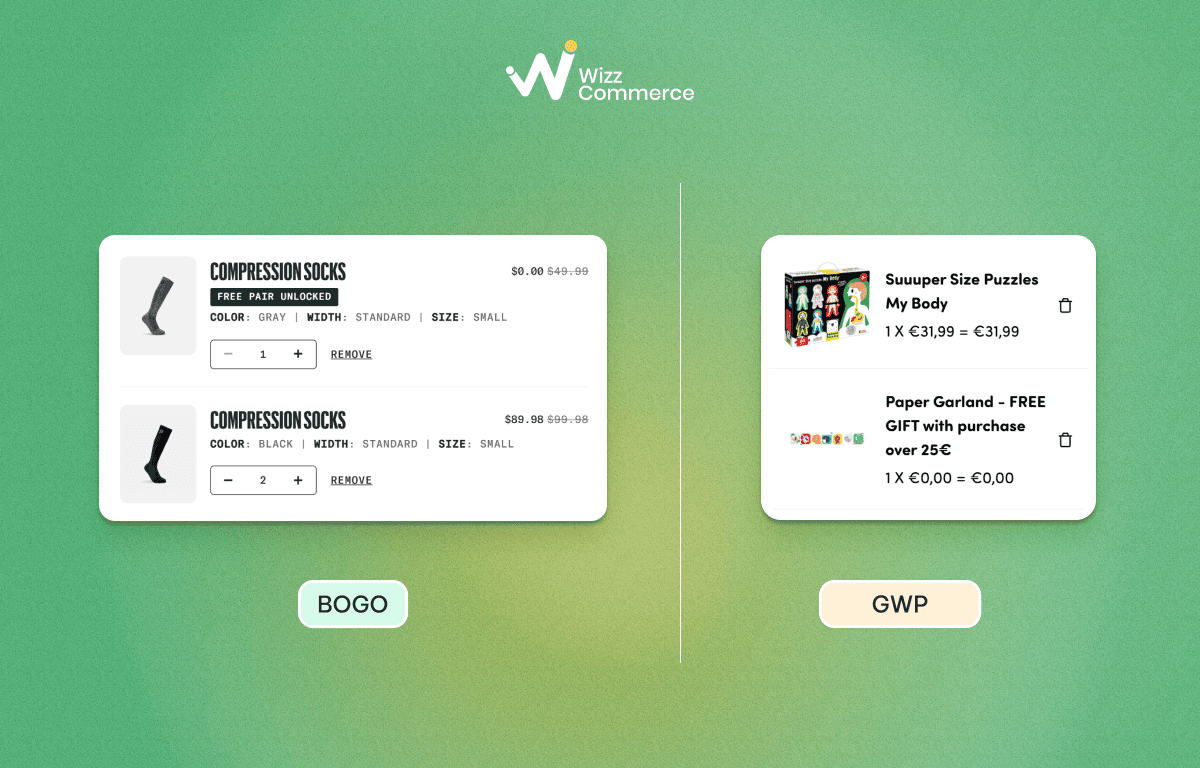
Compare BOGO vs free gifts.
4. When should you choose BOGO discounts or free gifts?
4.1 When to consider BOGO discounts
If your goal is to sell extra units and move inventory faster, BOGO is usually the more direct choice. It makes stocking up feel rational rather than risky when:
- Consumers already know the product and reasonably buy multiple units
- Margins are strong enough to support the incentive
- Additional items do not significantly increase shipping costs
Buy one get one free tends to be more attractive than an equivalent percentage discount. 66% of US consumers preferred buy one get one free to any other type of discount. 49% would switch brands for a BOGO deal.
- Use cases: Consumables, replenishment categories, accessories, seasonal goods, and short-term sales campaigns.
4.2 When to consider gift with purchase
A free gift often gives you more flexibility if the goal is raising average order value without discounting the main product. By setting a meaningful spending threshold, you can encourage buyers to add another item or upgrade their basket to qualify. Instead of lowering the product price, you're rewarding purchasers for spending more. Research found retailers using a threshold-based reward saw revenue increase 10-20% during the campaign.
Free gift promotions are also effective for product discovery. They allow customers to try a new scent, formula, flavor, shade or product line with little risk. If shoppers like it, they may come back and buy the full-price version later.
- Use cases: Samples, minis, add-ons, complementary items, premium brands, and higher-margin categories.
4.3 When neither offer makes sense
Neither BOGO nor a free gift is likely to work well if:
- Margins are already thin
- Inventory levels are unstable
- Your best-selling products should not be discounted in any form
Before adding an incentive, a better move might be to improve bundles, strengthen merchandising, or remove friction from the shopping journey.
5. How to set up free gift and BOGO promotions successfully
5.1 Build rules around the behavior you want to change
Align the qualification rules with the desired outcome.
- Bigger cart sizes: Set qualification above your current AOV.
- Product discovery: Require the purchase of a relevant anchor product.
- Inventory movement: Limit the offer to items or variants that actually need support.
For BOGO specifically, keep the conditions simple. Messages like Buy two, get one free are simpler to understand, communicate and measure than a long ladder of exclusions and exceptions.
For spend-threshold offers, the rule should be high enough to encourage an extra item but still feel attainable. The added revenue should cover the incentive cost and any extra fulfillment expense.
5.2 Decide between automatic and manual incentives
Automatic incentives can create a smoother shopping experience since buyers do not have to take extra steps to claim the reward. This helps reduce friction and lowers the chance of missing the promotion altogether. You can read this article to find out how to add free gifts to cart automatically.
However, requiring an action is sometimes still useful. Purchasers may actively decide their gifts from multiple options, creating a strong sense of achievement.
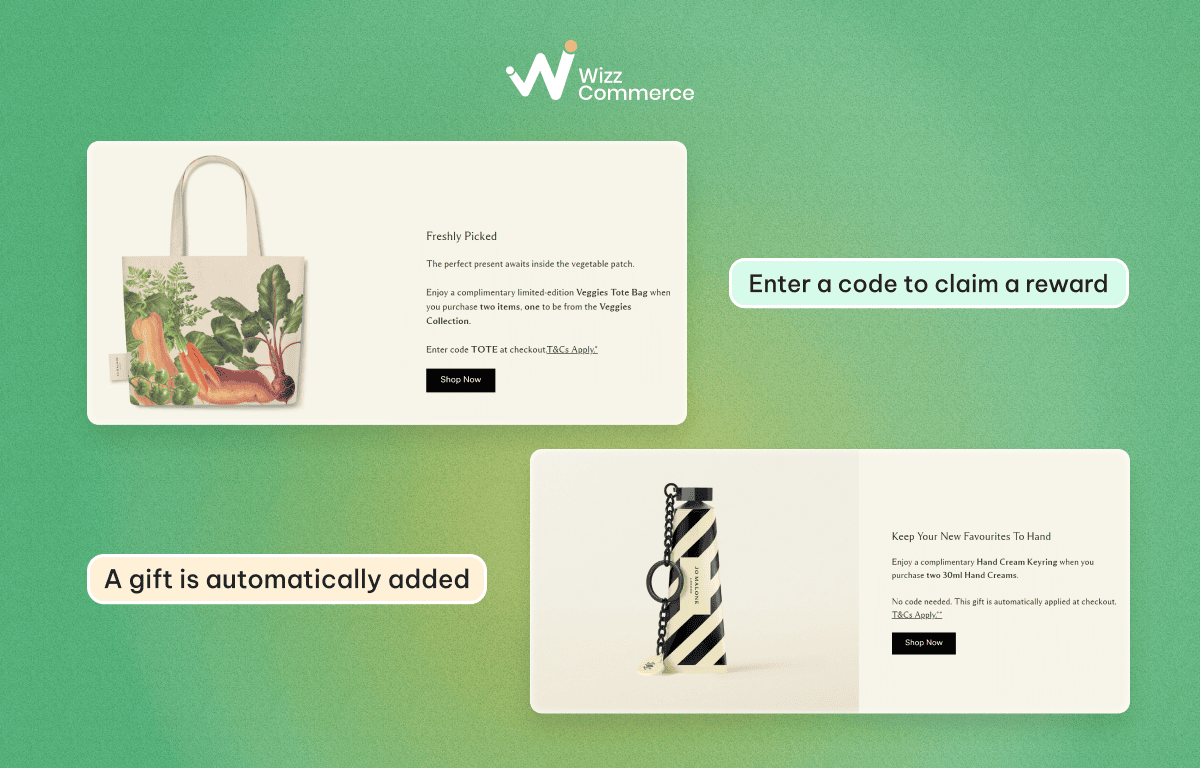
Choose between automatic application and manual selection.
Whichever approach you choose, the reward should feel transparent. Customers should know what they earned and why.
- For simplicity and conversion, implement automatic application.
- For engagement, add manual offers.
5.3 Avoid common profit issues
Many promotions lose profitability because of operational details rather than the offer itself. Before launching, define:
- Which products should be excluded
- Whether the promotion can stack with other discounts
- How many free items can be claimed per order
- What happens if the gift goes out of stock
- How returns will affect gift eligibility
6. How to test whether BOGO or free gifts are actually working
6.1 Track the right metrics
Determine which metrics matter most for business goals. A BOGO campaign designed to increase units sold does not have the same criteria as a free gift deal designed to raise order value. Based on your objective, track metrics such as:
6.2 Run a clean A/B test
Whenever possible, compare offers through an A/B test or across similar customer segments and time periods. Avoid drawing conclusions during unusual traffic periods, major campaigns, or stockouts.
Also consider what happens after the promotion:
- For free gifts, track whether purchasers who receive the gift later buy the featured product or category.
- For buy one get one, monitor whether buyers return at full price or wait for the next sale to order again.
Final recommendation
There is no universal winner between buy one get one free and free gifts. The best promotion not only changes customer behavior but also supports profitable growth. Before launching any offer, consider the full picture: margin, fulfillment costs, customer perception, and long-term buying behavior. Then measure success by business results, not just short-term sales.
FAQs
1. What is the difference between buy one get one deals and bonus gifts?
A BOGO deal gives shoppers another product for free or at a discount when they buy a qualifying item or quantity. A bonus gift rewards buyers with a bonus item for satisfying a purchase condition.
2. When should a brand use BOGO offer or gift with purchase?
Use BOGO offer when you need to increase units sold, move inventory and encourage stock-up orders. Apply gift with purchase to raise order value, introduce new products, preserve pricing and make the shopping journey more premium.
3. Can BOGO and free gift promotions be used together?
Yes, but be careful with stacking discounts. Combining both strategies can improve conversions, but it may also reduce profit and train customers to wait for bigger sales.