






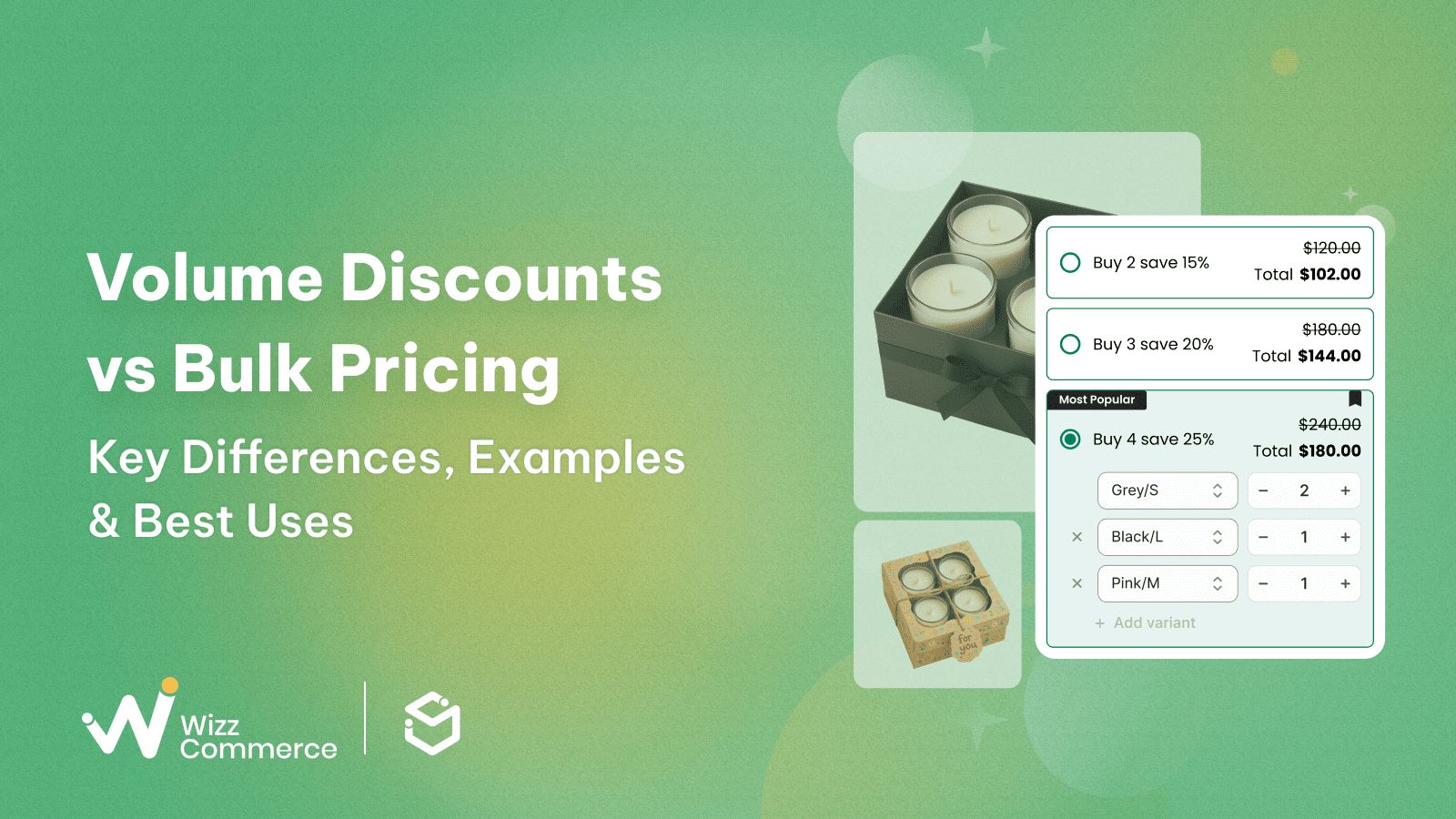
TL;DR
Volume discounts reward buyers with lower prices after crossing a specific quantity or spend threshold, making them ideal for increasing AOV. Conversely, bulk pricing offers a reduced unit price for purchasing large quantities upfront, perfect for B2B and wholesale. Choose the model that fits your audience while protecting your contribution margin.Volume discounts and bulk pricing come down to a simple question: what should happen to the price when a customer buys more? While both approaches reward larger purchases, they work differently. Volume discounts encourage customers to reach specific quantity or spending thresholds. Bulk pricing offers a lower unit price for larger quantities from the start.
Understanding the difference is important because the right pricing model can influence order size, profit margins, customer behavior, and operational efficiency. This guide compares volume pricing and bulk discounts, explains when each approach makes sense, and helps you choose the most suitable option for your business.
1. What are volume discounts?
Volume discounts are a pricing strategy that rewards customers for purchasing larger quantities. Instead of paying the same unit price no matter how much they order, buyers receive a lower price as their order size grows. The main goal is to encourage customers to buy more and increase average order value.
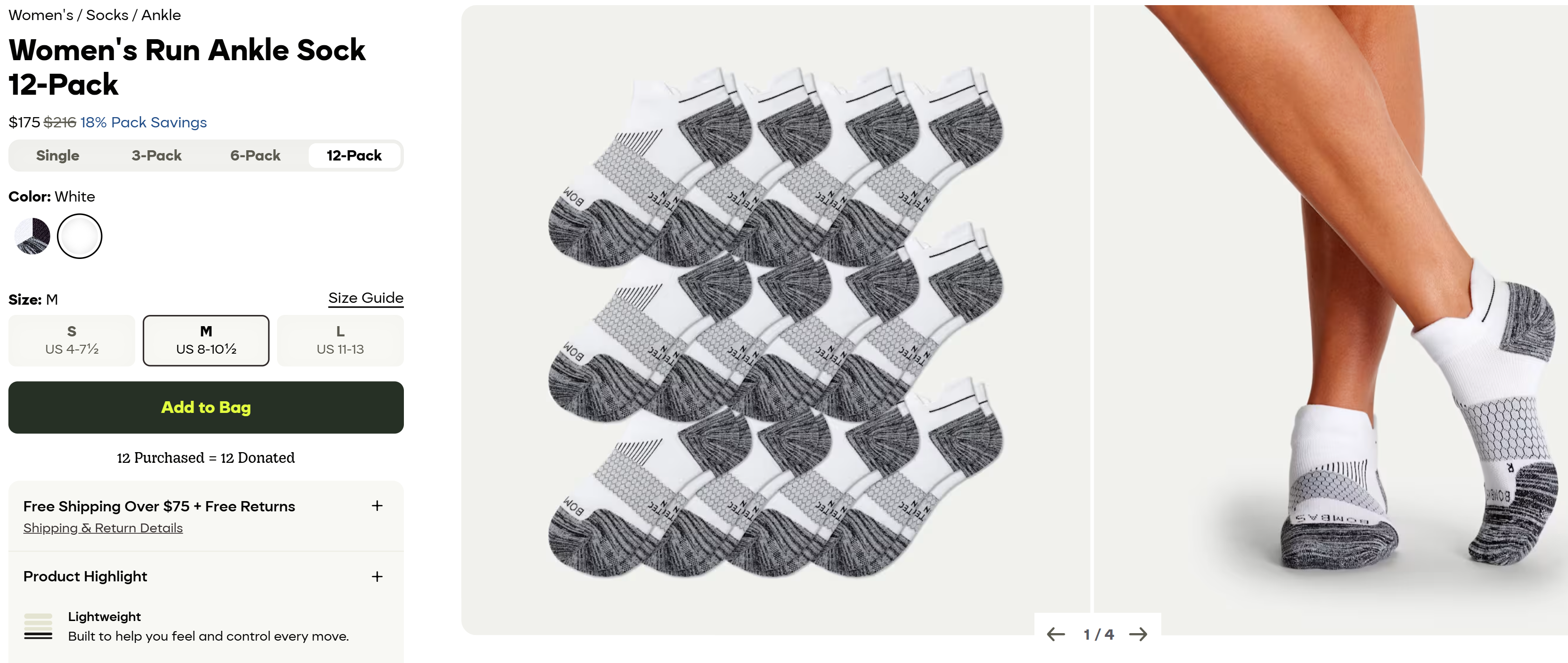
Buy 12 packs to unlock 18% discount.
There are several ways to structure volume-based pricing, such as:
- Tiered discounts - Apply different discount levels at predefined quantity thresholds.
- Buy More, Save More - Offer bigger savings when shoppers add more items to their cart.
- Bulk pricing - Assign lower unit pricing for high-volume orders.
- Spend-based volume discounts - Unlock discounts once purchasers hit a spending milestone.
2. What does bulk pricing mean?
Bulk pricing is one of the most common types of volume discounts. While quantity-based discounts refer to any pricing strategy that rewards larger purchases, bulk pricing specifically reduces the per-unit cost when customers buy more of the same product.
In many cases, it is combined with a minimum order quantity (MOQ). MOQ sets the minimum number of units required. Meanwhile, buying in bulk determines the discounted price they get after reaching that threshold.
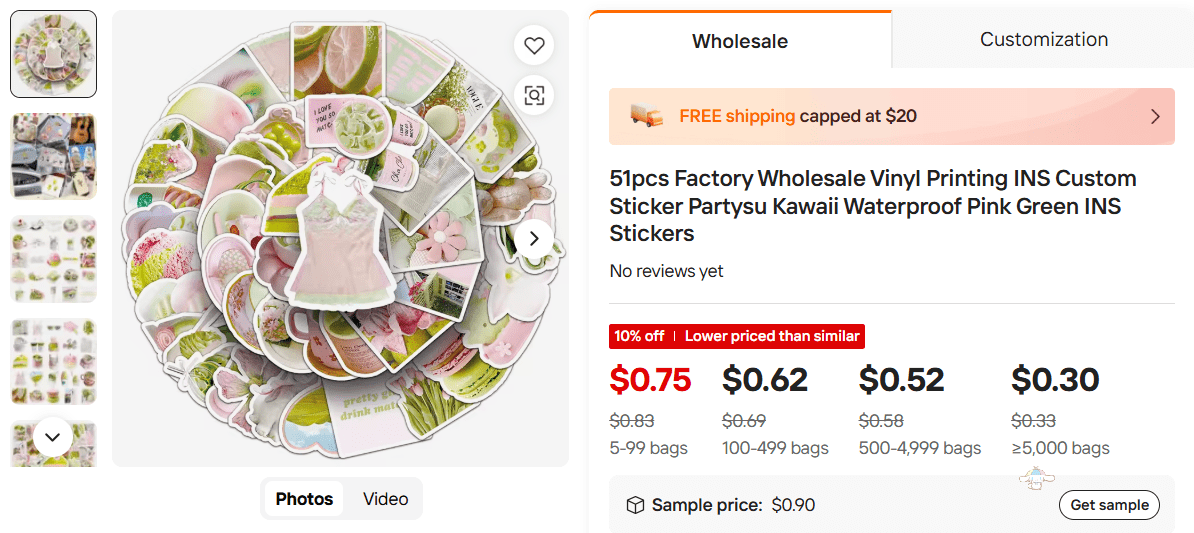
Bulk pricing is combined with MOQ at 5 bags.
3. What is the real difference between volume discounts and bulk pricing?
Many people use quantity discounts and bulk discount pricing interchangeably. However, bulk pricing is actually a specific type of price incentive. The key difference lies in how the lower price is triggered and presented to the buyer.
- Volume discounts reward customers for crossing a threshold.
- Bulk pricing offers a lower unit price for purchasing a larger quantity from the start.
4. How do volume pricing vs bulk pricing change customer behavior?
Remember that larger orders do not automatically mean higher profits. Businesses should test margins, fulfillment costs, and customer retention to ensure the strategy remains sustainable.
4.1. Why price breaks can increase average order value
Price breaks work best when the next threshold feels achievable. A buyer at $92 may move to $100 if the site says, “Save 5% at $100.” However, the same shopper is unlikely to increase their order to $250 just to qualify for the discount. The next pricing tier should be close enough to reach with one or two additional items.
4.2. When discounts encourage repeat buying
Discounts encourage repeat buying when they match how customers naturally use a product. A price reduction of 5-15% on a 6-bag coffee subscription may lead to regular reorders. In contrast, a discount above 25-30% on 40 bags may encourage buyers to stock up once and disappear for months.
Volume-based discounts tend to perform well when products are consumed regularly. Avoid deep bulk discounts on perishable, seasonal, or trend-driven products unless the goal is to clear inventory.
4.3. How visible tiered pricing affects customer behavior before checkout
Clear pricing tiers motivate shoppers to check whether buying more is worth the savings. This effect is much weaker when discounts are hidden until checkout.
However, too many tiers slow down the buying process. Three or four well-defined tiers are easier to scan than a long list of pricing options.
5. When should you choose between bulk discounts and quantity pricing?
The best pricing model depends on how your customers buy. Some shoppers need an incentive to increase their order size. Others already expect lower unit costs when shopping in larger quantities. The closer your pricing matches customer expectations, the better the results.
5.1. Use quantity-based pricing to encourage larger orders
By offering a better deal at quantity or spending thresholds, volume discounts create a clear reason to add more items to the cart. This approach is common in ecommerce stores, subscription products, and SaaS companies.
However, be careful not to discount purchases that customers would have made anyway. Otherwise, the promotion reduces margins without generating extra sales.
5.2. Use bulk discounts when customers already buy in bulk
Bulk pricing is most valuable in wholesale and B2B sales, where big orders are already part of the buying process. Larger quantities come with lower per-unit pricing from the start. Thus, customers can quickly compare costs across cases, cartons, pallets, or production runs. One challenge is that profitability can suffer if small buyers gain access to bulk rates.
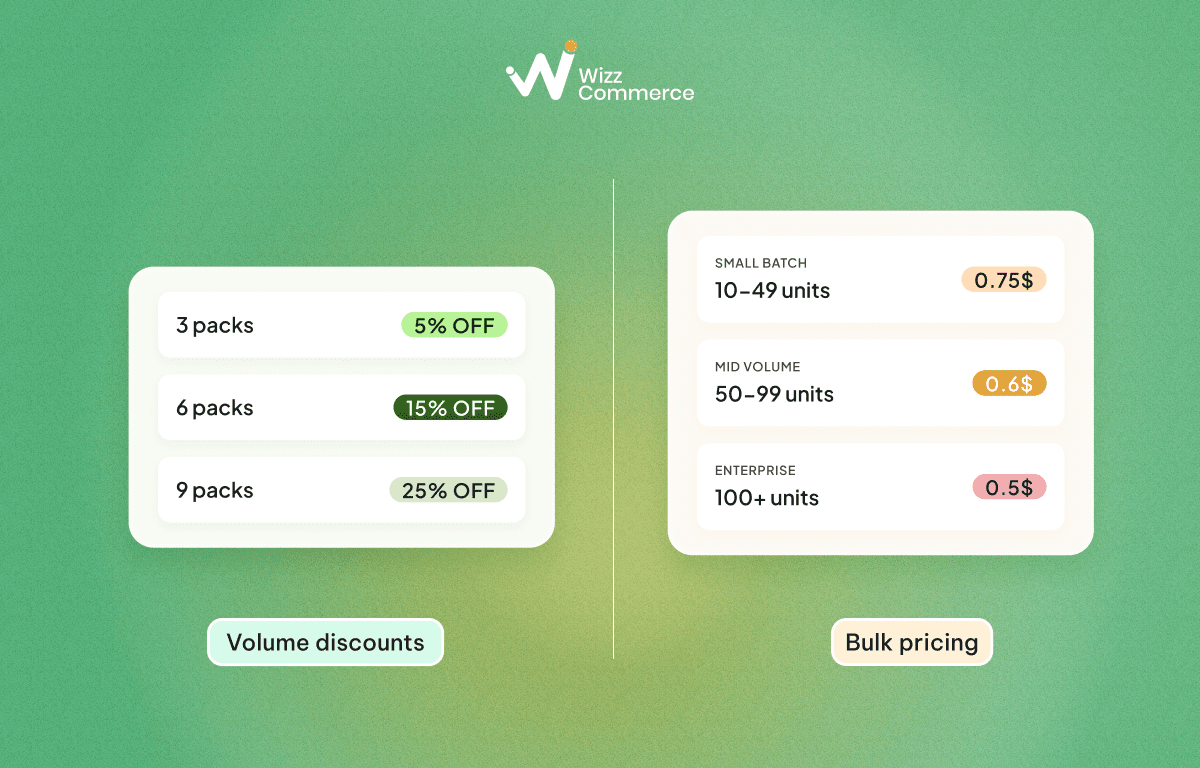
Compare volume and bulk pricing to know when each pricing model works best.
5.3. Use contract-based pricing for B2B and SaaS sales
B2B buying is often more complicated than many merchants realize. In a Gartner survey, 77% of more than 250 B2B buyers described their shopping experience as extremely complex or difficult. For B2B and SaaS companies, quantity is only part of the pricing decision. The support level, custom integrations, or longer-term agreements can all influence the final price.
As deals become more complex, fixed pricing tiers rarely reflect the full cost of serving the customer. Negotiated pricing gives businesses more flexibility to meet specific needs while protecting margins.
5.4. Use minimum order quantities when operational costs matter most
Sometimes the priority is not increasing sales but ensuring orders remain profitable.
A minimum order quantity (MOQ) helps by setting the smallest order a customer can place. This prevents businesses from spending too much time and money on very small orders.
5.5. Consider a hybrid approach for multiple customer segments
Lots of buyers no longer rely on a single purchasing channel. McKinsey found that digital self-service, remote interactions, and in-person sales each account for roughly one-third of B2B buying activity.
The biggest advantage of hybrid approach is flexibility. Retail shoppers may respond well to volume discounts, while wholesale buyers may expect bulk pricing. Likewise, a SaaS brand might publish standard plans for most customers, but offer custom pricing for businesses.
6. How do you calculate discounts without damaging profit margins?
Revenue can rise while profit falls. Before offering any breakdown, make sure the extra sales are worth the lower price.
- Start with gross margins: Understand how much profit you make on each sale. This sets the limit for how much you can discount without hurting profitability.
- Include all variable costs: Do not consider only product costs. Shipping, fulfillment, packaging, payment fees, and labor can all raise as order volume grows. The more accurately you account for these costs, the easier it becomes to set sustainable discount levels.
- Measure contribution margin: Show how much money remains after product and variable costs are deducted.
Use this metric to see whether a discount still leaves enough profit after each sale.
- Suppose a customer normally buys 10 units at $100 each, generating $400 in total contribution margin. The seller introduces bulk pricing of $92 per unit for orders of 20 units.
Contribution margin becomes: $92 − $50 − $10 = $32 per unit
Total contribution margin: 20 × $32 = $640
Although margin per unit falls, total order profit increases by 60%.
- Focus on total order profit: Avoid evaluating breakdowns based on unit price alone. Compare the profit generated by the entire order. If higher fulfillment costs outweigh the total profit, the discount may do more harm than good.
7. How to show savings clearly without confusing buyers
Even the best discount strategy can fail if customers do not understand the offer. Here are some smart ways to explain your bulk prices:
- Consider a pricing structure shoppers can follow.
- All-unit pricing is simpler because the discounted price applies to every unit once threshold is reached.
- Graduated pricing offers more control over margins but may need further explanation.
- Display the next savings opportunity by simple messages. Purchasers are more likely to act when they know exactly what to do.
- Keep pricing tiers simple. Too many quantity breaks can overwhelm buyers and slow purchasing decisions. Three or four clear tiers are usually enough.
- Present important pricing details upfront. For wholesale and B2B purchases, introduce the unit price, minimum order quantity, and any conditions attached to the offer. Buyers should not have to search for information before calculating their costs.
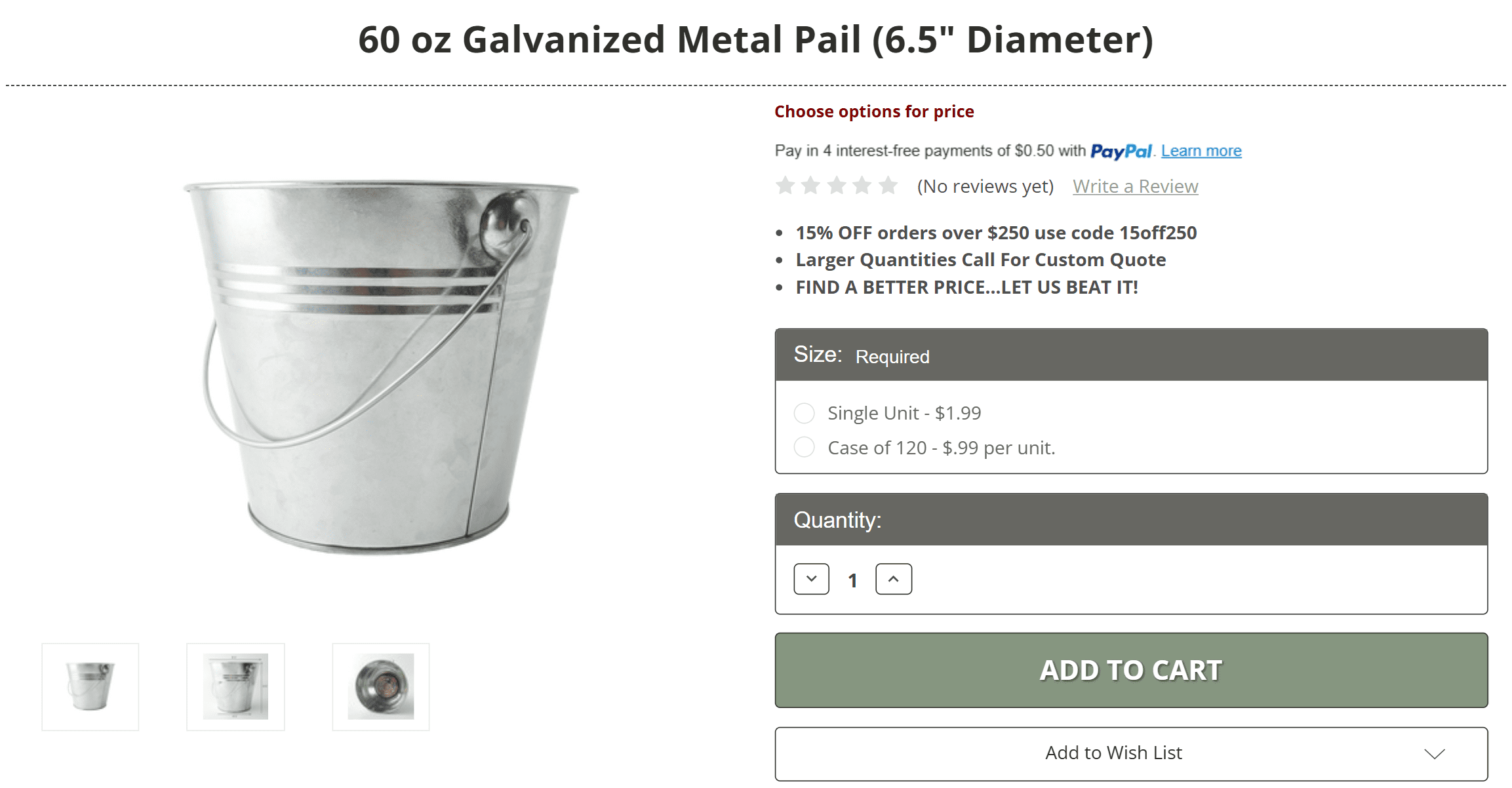
Clearly show conditions to qualify for bulk savings.
8. When can volume pricing or bulk pricing backfire?
8.1. Customers start waiting for lower prices
Frequent promotions can train customers to delay purchases until the next sale. Research published by the U.S. National Institutes of Health found that repeated discount cycles make shoppers more strategic over time.
Instead, apply consistent pricing tiers. Customers learn that larger orders earn better pricing, without expecting a temporary sale every few weeks.
8.2. Large orders increase operational costs
Big purchases may require additional packaging, storage, freight coordination, or manual processing. Higher operating costs can reduce the profit gained from selling more units.
Before launching bulk discounts, ensure these costs are still manageable at higher order volumes.
8.3. Discounts attract one-time customers
A huge promotion may boost sales for a short time, but not build long-term customer loyalty. Many shoppers buy just because of price deductions and never come back once prices go back to normal.
Compare repeat purchase rates for discounted buyers against full-price buyers. If discounted customers rarely return, the offer may need a higher milestone or a different structure.
8.4. Sales teams give away too much margin
Negotiated pricing can become a problem when discounts are approved too easily. Clear approval rules help prevent unnecessary discounting. Pricing decisions should consider profit margins, not just revenue or order size.
Final thoughts
There is no universal winner between quantity discounts and bulk pricing. The most effective approach not only motivates the right buying behavior but also keeps margin healthy. When your pricing model reflects both buyer expectations and operating costs, larger orders can become a reliable source of sustainable growth.
Frequently asked questions
1. What is the difference between volume discounts and bulk pricing?
Volume discounts usually reduce the price after a customer buys above certain quantity or spend thresholds. Bulk pricing often sets a lower unit price for a large quantity from the start.
2. Can volume-based pricing hurt profit margins?
Yes. Price deductions can harm profits if the savings are too generous or if bigger orders increase operational costs. Always calculate margins before setting discount tiers.
3. What is the best way to show price breaks to customers?
Keep it simple and visible before checkout. Show the unit price, quantity threshold, and potential savings so customers can easily understand the offer.